

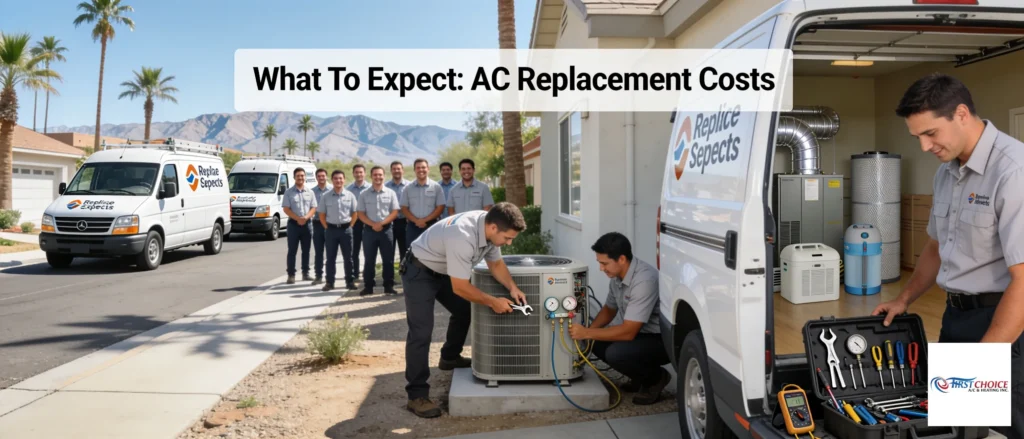
What To Expect in AC Replacement
AC replacement vary considerably for most homeowners, covering both equipment and installation. Factors like unit size, SEER rating, and local labor rates all affect the final figure. At First Choice AC & Heating Inc., we provide professional assessments for homeowners in Palm Desert, CA to ensure every quote is tailored to your specific home cooling needs — not based on a generic estimate.
Residential AC replacement costs shift based on labor, permits, and system size. That spread reflects real differences in capacity, efficiency ratings, and installation complexity. We assess every contributing factor — including ductwork condition — before recommending any equipment, so our clients receive figures that reflect their actual situation.
Key Takeaways
Residential AC replacement is a meaningful investment that includes labor and permit fees alongside equipment. Understanding each cost category before you commit helps you avoid budget surprises and make a confident decision.
Complete HVAC system replacements reach a significantly higher total than AC-only swaps, depending on system size and installation complexity. The right replacement path depends on what your existing infrastructure can support.
System type, energy efficiency ratings, and home size directly drive the final replacement investment. Choosing equipment that matches your home’s actual cooling load protects both performance and long-term value.
First Choice AC & Heating Inc. helps homeowners in Palm Desert, CA navigate these significant replacement decisions. We walk every client through their options before a single recommendation is made.
Residential AC replacement is a meaningful investment that includes labor and permit fees alongside equipment. Understanding each cost category before you commit helps you avoid budget surprises and make a confident decision.
Complete HVAC system replacements reach a significantly higher total than AC-only swaps, depending on system size and installation complexity. The right replacement path depends on what your existing infrastructure can support.
System type, energy efficiency ratings, and home size directly drive the final replacement investment. Choosing equipment that matches your home’s actual cooling load protects both performance and long-term value.
First Choice AC & Heating Inc. helps homeowners in Palm Desert, CA navigate these significant replacement decisions. We walk every client through their options before a single recommendation is made.
Why Does AC Replacement Cost So Much?
AC replacement cost climbs quickly because residential projects involve far more than simply swapping one unit for another. Labor, permits, system sizing, efficiency ratings, and existing infrastructure all drive the final number — and each variable compounds the last.
For a standard residential AC-only replacement, the total varies and already folds in labor and permit fees. When a full system overhaul is needed, the range expands considerably depending on system type, home size, and installation complexity.
What factors push the price higher?
Several variables determine where a project lands within that wide range:
System capacity — Larger homes require higher-tonnage equipment, which carries a proportionally greater equipment cost. Undersizing a system to reduce upfront spend almost always results in higher operating costs and premature failure.
Energy efficiency ratings — Higher-efficiency models reduce long-term operating expenses but carry a greater upfront investment. The trade-off pays off over time, particularly in a high-demand desert climate like Palm Desert, CA.
New AC price — Variable-speed and smart-compatible systems command a premium over single-stage units. That premium reflects genuine performance advantages — more precise temperature control and lower monthly utility consumption.
Existing infrastructure — Ductwork condition, electrical capacity, and insulation quality all affect how much modification work is required before installation begins. Issues discovered mid-project are among the most common sources of budget overruns.
Permits and inspections — Local code compliance adds fees that vary by municipality. We handle the permitting process on behalf of our clients so nothing gets missed and the installation is fully code-compliant.
System capacity — Larger homes require higher-tonnage equipment, which carries a proportionally greater equipment cost. Undersizing a system to reduce upfront spend almost always results in higher operating costs and premature failure.
Energy efficiency ratings — Higher-efficiency models reduce long-term operating expenses but carry a greater upfront investment. The trade-off pays off over time, particularly in a high-demand desert climate like Palm Desert, CA.
New AC price — Variable-speed and smart-compatible systems command a premium over single-stage units. That premium reflects genuine performance advantages — more precise temperature control and lower monthly utility consumption.
Existing infrastructure — Ductwork condition, electrical capacity, and insulation quality all affect how much modification work is required before installation begins. Issues discovered mid-project are among the most common sources of budget overruns.
Permits and inspections — Local code compliance adds fees that vary by municipality. We handle the permitting process on behalf of our clients so nothing gets missed and the installation is fully code-compliant.
Is a full HVAC replacement always more expensive than an AC-only swap?
Not always — but the gap is significant when the full system needs attention. Replacing only the cooling component keeps costs within the lower end of the residential range, while replacing the entire HVAC system, including heating and air handling, pushes the project toward the upper boundary of the range. HVAC installation cost reflects the full scope of that work, not just the equipment itself.
At First Choice AC & Heating Inc., our Palm Desert, CA team evaluates every component of a system before recommending a replacement path. Coachella Valley homes face extreme seasonal demand, and an undersized or mismatched system fails faster — adding far more expense over time than a properly specified installation from the start.
What Factors Drive the New AC Price?
New AC price varies based on a combination of system-level variables, home infrastructure conditions, and the scope of work required at installation. Skipping a thorough evaluation of these factors before replacement leads to budget surprises and underperforming equipment.
Several distinct variables shape the final AC replacement cost:
System capacity and power — A unit sized incorrectly for your home wastes energy and wears out faster than it should. We size every system to your home’s actual cooling load, not a ballpark estimate.
Efficiency rating — Higher-efficiency systems carry a greater upfront investment but reduce long-term operating expenses meaningfully. Over the life of the equipment, that difference compounds into real savings on monthly utility bills.
Existing HVAC equipment — Components you retain, such as air handlers or coils, affect what new equipment must be compatible with. We inventory your existing system before making any recommendation to avoid compatibility issues.
Required system modifications — Reconfiguring refrigerant lines, electrical connections, or mounting pads adds to the total. We identify every modification requirement during our initial inspection so nothing surfaces unexpectedly mid-project.
Line set protection — Protecting refrigerant lines from UV exposure and physical damage is a separate material and labor consideration. In Palm Desert, CA, UV intensity accelerates line degradation, making this a necessary investment rather than an optional add-on.
Available tax credits and rebates — Federal and utility incentives offset a portion of the HVAC installation cost, though eligibility depends on the equipment selected. We walk every client through applicable programs before finalizing an equipment recommendation.
System capacity and power — A unit sized incorrectly for your home wastes energy and wears out faster than it should. We size every system to your home’s actual cooling load, not a ballpark estimate.
Efficiency rating — Higher-efficiency systems carry a greater upfront investment but reduce long-term operating expenses meaningfully. Over the life of the equipment, that difference compounds into real savings on monthly utility bills.
Existing HVAC equipment — Components you retain, such as air handlers or coils, affect what new equipment must be compatible with. We inventory your existing system before making any recommendation to avoid compatibility issues.
Required system modifications — Reconfiguring refrigerant lines, electrical connections, or mounting pads adds to the total. We identify every modification requirement during our initial inspection so nothing surfaces unexpectedly mid-project.
Line set protection — Protecting refrigerant lines from UV exposure and physical damage is a separate material and labor consideration. In Palm Desert, CA, UV intensity accelerates line degradation, making this a necessary investment rather than an optional add-on.
Available tax credits and rebates — Federal and utility incentives offset a portion of the HVAC installation cost, though eligibility depends on the equipment selected. We walk every client through applicable programs before finalizing an equipment recommendation.
Does ductwork condition affect the total replacement cost?
Ductwork condition directly determines whether a new high-efficiency system delivers its rated performance. Gaps or deterioration in duct runs allow conditioned air to escape before it reaches living spaces — erasing the efficiency gains a premium unit is designed to provide. Addressing duct deficiencies at the time of replacement is not optional; it is a prerequisite for a sound investment.
Home insulation quality compounds this issue significantly. Poor insulation forces any new system to work harder, shortening equipment life and inflating monthly utility bills — outcomes that undermine the entire purpose of a quality replacement.
Why does a full system inspection matter before replacement?
At First Choice AC & Heating Inc., our process begins with a comprehensive inspection of the entire HVAC system — not just the failing unit. That inspection surfaces hidden inefficiencies, from compromised duct sections to undersized electrical circuits, that would otherwise undermine the performance of new equipment. Identifying every cost-affecting issue upfront allows us to provide an accurate scope of work and protect the long-term value of your replacement investment.
How Do AC System Types Affect Total Cost?
AC replacement cost varies dramatically based on the type of system a home requires. Window units sit at the most affordable end of the spectrum, while full central air systems with ductwork represent the largest investment a homeowner can make in residential cooling.
At First Choice AC & Heating Inc., we work with a broad range of HVAC equipment — central air systems, heat pumps, furnaces, and ductless systems — because no two homes in Palm Desert, CA have identical needs. The right system type determines not just the upfront new AC price, but also long-term operating costs and comfort performance.
What Is the Price Range Between System Types?
The gap between system types is significant, and understanding where your home falls within that range is exactly what our team helps you determine. A window unit replacement sits at the most affordable end of the spectrum, while replacing an entire central air system with ductwork represents a substantially larger investment.
System Type
Approximate Replacement Range
Window Unit
Most affordable end of the spectrum
Ductless Mini-Split
Mid-range investment
Central Air (existing ductwork)
Mid-to-high investment
Central Air (with ductwork)
Highest investment range
Does System Sophistication Drive Up HVAC Installation Cost?
Yes — technology level directly affects HVAC installation cost. Variable-speed AC systems, which modulate output to match real-time cooling demand, sit at the higher end of the replacement range due to their advanced components and more complex installation requirements. The trade-off is meaningful: greater precision typically delivers better energy efficiency and more consistent indoor comfort over the system’s lifespan.
Choosing the right system type is not simply a budget decision — it is a long-term performance decision. Our team evaluates your home’s size, existing infrastructure, and efficiency goals before recommending any equipment, because the lowest upfront cost does not always produce the lowest total cost of ownership. We encourage every homeowner to explore the full range of AC replacement options so they understand what each system type offers before committing.
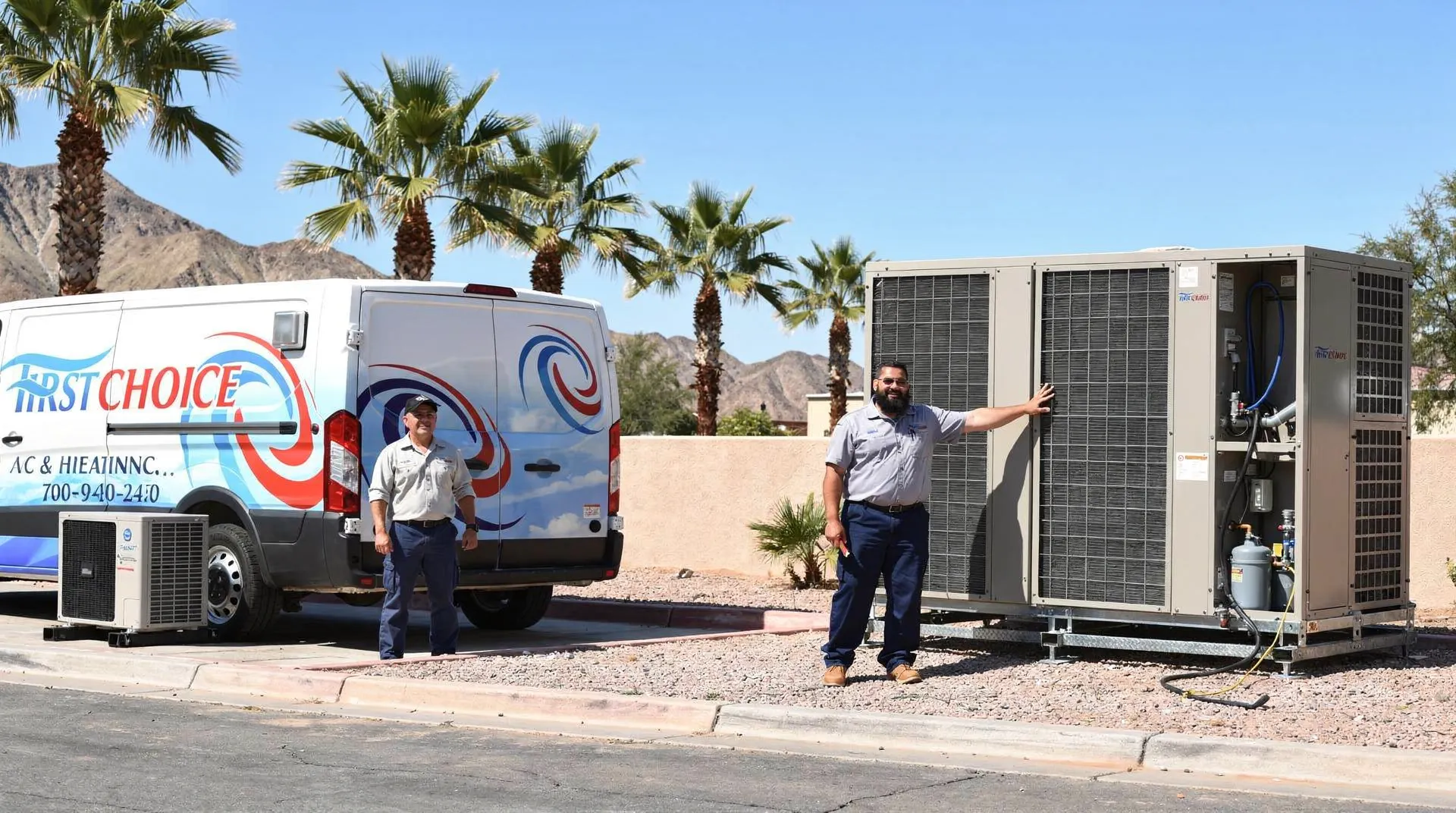
Does Higher Efficiency Justify the Upfront HVAC Installation Cost?
Higher efficiency almost always justifies the greater HVAC installation cost — while standard models offer a lower entry point, high-efficiency systems deliver operational savings that compound month after month, year after year. The real question is not whether to invest in efficiency, but how to evaluate the trade-off honestly.
At First Choice AC & Heating Inc., we make every effort to improve a home’s overall energy efficiency during every replacement project. A new high-efficiency unit installed into a leaky, under-insulated system will not perform as designed — which is why we inspect the entire system, including ductwork, insulation, and all connected components, before recommending any equipment.
What Is the Difference Between Standard and High-Efficiency Systems?
Standard efficiency models carry a more affordable upfront new AC price, making them attractive for budget-conscious homeowners. High-efficiency systems cost more at purchase, but the gap narrows over time as reduced energy consumption lowers monthly utility bills — and those savings accumulate meaningfully across the full service life of the equipment.
Factor
Standard Efficiency
High Efficiency
Upfront investment
Lower
Higher
Monthly operating cost
Higher
Lower
Long-term savings potential
Moderate
Significant
Does a Higher-Efficiency Unit Always Lower My AC Replacement Cost Over Time?
A higher-efficiency unit lowers the AC replacement cost equation over its lifetime — but only when the surrounding system supports it. If ductwork has significant gaps or insulation is inadequate, even a premium unit cannot deliver its rated savings, which is why our team identifies those energy losses before installation rather than after. The efficiency rating on the equipment label only translates into real reductions on the utility bill when the entire system is addressed, not just the unit itself.
What Are the Hidden Costs of AC Replacement?
AC replacement cost extends well beyond the sticker price of the equipment itself. Labor, permit fees, ductwork modifications, and regional equipment mandates all add to the final bill — and overlooking any one of them turns a planned budget into an unwelcome surprise.
Residential AC replacement in a single-family home varies in total, and that figure already folds in labor and permit fees. Even so, several line items consistently catch homeowners off guard before the project is complete.
What Additional Work Can Drive Up the Total?
Existing infrastructure is the most common source of budget overruns on replacement projects. When ductwork has gaps, deterioration, or undersized runs, those issues must be addressed before a new system can perform at rated efficiency — and at First Choice AC & Heating Inc., our team inspects the entire system before quoting a replacement precisely because installing high-efficiency equipment into a compromised duct system wastes the investment from day one.
Common hidden cost categories include:
HVAC installation cost increases tied to duct repairs or rerouting — Damaged or undersized duct sections reduce system performance and must be corrected before new equipment is commissioned. Addressing them at replacement time avoids a separate, more disruptive service call later.
Electrical upgrades required to support higher-capacity equipment — Older homes in Palm Desert, CA may have panels or wiring that cannot safely support a modern high-efficiency system. We assess electrical capacity during our initial inspection so there are no discoveries mid-installation.
Permit fees mandated by local building codes — Every permitted installation protects the homeowner by ensuring the work meets safety and performance standards. We manage the permitting process on your behalf so compliance is never an afterthought.
Line set protection or refrigerant line replacement — Exposed refrigerant lines degrade under prolonged UV exposure, and replacement or protective sheathing is often necessary. In the desert climate of Palm Desert, CA, this is a particularly relevant consideration.
Disposal fees for the old unit — Proper removal and disposal of refrigerant-containing equipment is regulated, and that process carries its own cost. We handle disposal responsibly and include it in our project scope.
HVAC installation cost increases tied to duct repairs or rerouting — Damaged or undersized duct sections reduce system performance and must be corrected before new equipment is commissioned. Addressing them at replacement time avoids a separate, more disruptive service call later.
Electrical upgrades required to support higher-capacity equipment — Older homes in Palm Desert, CA may have panels or wiring that cannot safely support a modern high-efficiency system. We assess electrical capacity during our initial inspection so there are no discoveries mid-installation.
Permit fees mandated by local building codes — Every permitted installation protects the homeowner by ensuring the work meets safety and performance standards. We manage the permitting process on your behalf so compliance is never an afterthought.
Line set protection or refrigerant line replacement — Exposed refrigerant lines degrade under prolonged UV exposure, and replacement or protective sheathing is often necessary. In the desert climate of Palm Desert, CA, this is a particularly relevant consideration.
Disposal fees for the old unit — Proper removal and disposal of refrigerant-containing equipment is regulated, and that process carries its own cost. We handle disposal responsibly and include it in our project scope.
Do Regional Regulations Affect What Equipment We Can Install?
Regional regulations directly shape equipment choices — and therefore new AC price points. Southern California has required specific equipment types for HVAC replacement, and that mandate limits available options while shifting costs compared to what a homeowner might see quoted in another state or climate zone. Our team stays current on all applicable Southern California requirements and walks every client through compliant equipment options so there are no regulatory surprises after the project begins.
Can Tax Credits and Rebates Reduce Your AC Replacement Cost?
Tax credits and rebates directly lower the net AC replacement cost for homeowners who qualify. Factoring in available incentives is one of the most effective ways to reduce total out-of-pocket spending on a new system, and it is a step we take with every client before a project begins.
At First Choice AC & Heating Inc., we walk every homeowner in Palm Desert, CA through the incentive landscape before finalizing an equipment recommendation. The goal is straightforward: make sure no available savings go unclaimed. Clients who schedule a replacement consultation with us early in the process have the most opportunity to qualify for time-sensitive programs.
What Types of Incentives Can Lower My AC Replacement Cost?
Several categories of savings can reduce what you ultimately pay:
Federal tax credits — Available for qualifying high-efficiency systems and applied when you file your annual return. Eligibility depends on the specific equipment selected, which is why we review applicable credits before finalizing your system recommendation.
Utility rebates — Local utility providers sometimes offer cash-back programs for energy-efficient equipment upgrades. These programs have limited availability and specific enrollment windows, so acting promptly matters.
State and local programs — Regional incentive programs may apply depending on where the installation takes place. We stay current on available programs in Palm Desert, CA so our clients never have to research eligibility on their own.
Manufacturer rebates — Equipment brands periodically offer limited-time rebates on select product lines. We track current manufacturer promotions and factor them into every project estimate we provide.
Federal tax credits — Available for qualifying high-efficiency systems and applied when you file your annual return. Eligibility depends on the specific equipment selected, which is why we review applicable credits before finalizing your system recommendation.
Utility rebates — Local utility providers sometimes offer cash-back programs for energy-efficient equipment upgrades. These programs have limited availability and specific enrollment windows, so acting promptly matters.
State and local programs — Regional incentive programs may apply depending on where the installation takes place. We stay current on available programs in Palm Desert, CA so our clients never have to research eligibility on their own.
Manufacturer rebates — Equipment brands periodically offer limited-time rebates on select product lines. We track current manufacturer promotions and factor them into every project estimate we provide.
Does My Location Affect How Much I Pay for AC Replacement?
Location influences the total new AC price in more ways than one. Homeowners in lower cost-of-living areas typically pay less for labor, which reduces the overall HVAC installation cost before any incentives are applied. Palm Desert, CA sits within a competitive regional market, and our team stays current on local labor conditions to provide accurate, transparent estimates that reflect real costs in this area.
We recommend reaching out to our team directly to identify which incentive programs currently apply to your specific system and location. Incentive availability changes throughout the year, and professional guidance ensures you capture every dollar available to you.
When Should You Replace Rather Than Repair Your AC?
Replacing an aging air conditioning system ranks among the most significant home investment decisions a homeowner faces — comparable to replacing a roof or major appliances. Knowing when repair costs no longer justify the expense protects both comfort and long-term budget, and it is a determination our team makes carefully with every client.
At First Choice AC & Heating Inc., our team brings over 15 years of expertise serving homeowners in Palm Desert, CA. From straightforward fixes to complex system failures, we diagnose every situation thoroughly before recommending a path forward — because our clients deserve an honest assessment, not a reflexive recommendation to replace.
How Do You Know If Repair Costs Are Too High?
A widely used benchmark is the AC replacement cost rule: when a single repair approaches or exceeds 50% of the new AC price, replacement typically delivers better long-term value. Repeated breakdowns compound that math quickly, and an aging system demanding frequent service calls drains your budget without restoring reliable performance — two factors that together make a compelling case for replacement.
What Signs Point Toward Full HVAC Replacement?
Watch for these indicators that replacement outweighs repair:
System age — Most central AC units have a functional lifespan of roughly 15–20 years, and units approaching that range lose efficiency steadily as components wear. A system in its final years of useful life is unlikely to repay the cost of major repairs.
Rising energy bills — Declining efficiency forces the system to run longer cycles, increasing operating costs month over month. If utility bills have been climbing without a change in usage habits, the system’s performance is almost certainly the cause.
Frequent breakdowns — Multiple failures within a single cooling season signal systemic decline rather than isolated component issues. Each repair extends a system that is already past its prime, and those costs accumulate quickly.
Inadequate cooling — Uneven temperatures or humidity problems often reflect a system no longer sized or functioning correctly for the home. These comfort issues tend to worsen over time and cannot be resolved by repairs alone.
Refrigerant issues — Older systems using phased-out refrigerant types face escalating service costs as supply availability shrinks. The cost of refrigerant servicing on a legacy system can approach or exceed the value of the repair itself.
System age — Most central AC units have a functional lifespan of roughly 15–20 years, and units approaching that range lose efficiency steadily as components wear. A system in its final years of useful life is unlikely to repay the cost of major repairs.
Rising energy bills — Declining efficiency forces the system to run longer cycles, increasing operating costs month over month. If utility bills have been climbing without a change in usage habits, the system’s performance is almost certainly the cause.
Frequent breakdowns — Multiple failures within a single cooling season signal systemic decline rather than isolated component issues. Each repair extends a system that is already past its prime, and those costs accumulate quickly.
Inadequate cooling — Uneven temperatures or humidity problems often reflect a system no longer sized or functioning correctly for the home. These comfort issues tend to worsen over time and cannot be resolved by repairs alone.
Refrigerant issues — Older systems using phased-out refrigerant types face escalating service costs as supply availability shrinks. The cost of refrigerant servicing on a legacy system can approach or exceed the value of the repair itself.
Understanding the full HVAC installation cost weighed against ongoing repair expenses is the clearest way to make a sound decision. Our experienced team evaluates every factor — from system age to ductwork condition — so homeowners in Palm Desert, CA receive an honest, complete assessment before committing to any investment. You can also learn more about our repairto understand how we approach each diagnosis.
How Can First Choice AC & Heating Inc. Help You Plan Replacement?
First Choice AC & Heating Inc. guides homeowners in Palm Desert, CA through every stage of the replacement process — from initial system assessment to final installation. Understanding the full scope of AC replacement cost, new AC price, and HVAC installation cost is far easier with a local expert in your corner who knows the specific demands this climate places on residential HVAC equipment.
Our team serves Palm Desert, CA and the surrounding Coachella Valley communities. Desert climate conditions place unique demands on HVAC equipment, and our familiarity with those conditions shapes every recommendation we make — from system selection to ductwork evaluation to efficiency planning.
What Does First Choice AC & Heating Inc. Offer During the Planning Stage?
We evaluate your existing system, ductwork, and home layout before recommending any replacement equipment. That whole-system view prevents homeowners from investing in a high-efficiency unit only to lose those gains through leaky ducts or undersized infrastructure — and our 5-star reputation is built on exactly this kind of thorough, honest guidance.
Here is what our replacement planning process covers:
System capacity assessment — We match equipment size to your home’s actual cooling load, not an approximate figure based on square footage alone. An accurately sized system runs more efficiently, lasts longer, and keeps your home consistently comfortable.
Efficiency review — We identify where energy losses occur in your existing system before any new equipment is selected. Addressing those losses first ensures the efficiency rating on your new unit translates directly into savings on your utility bill.
Infrastructure inspection — We evaluate ductwork, electrical supply, and existing components to surface any issues that would affect new equipment performance. Nothing discovered during installation should come as a surprise to you or to us.
Cost breakdown — We walk through every factor that influences total installation investment clearly and transparently. Our clients leave the planning stage with a complete picture of what the project involves and why each line item is necessary.
System capacity assessment — We match equipment size to your home’s actual cooling load, not an approximate figure based on square footage alone. An accurately sized system runs more efficiently, lasts longer, and keeps your home consistently comfortable.
Efficiency review — We identify where energy losses occur in your existing system before any new equipment is selected. Addressing those losses first ensures the efficiency rating on your new unit translates directly into savings on your utility bill.
Infrastructure inspection — We evaluate ductwork, electrical supply, and existing components to surface any issues that would affect new equipment performance. Nothing discovered during installation should come as a surprise to you or to us.
Cost breakdown — We walk through every factor that influences total installation investment clearly and transparently. Our clients leave the planning stage with a complete picture of what the project involves and why each line item is necessary.
What If My AC Fails Unexpectedly?
Emergencies do not follow business hours, and a system failure in the middle of a Palm Desert, CA summer demands an immediate response. First Choice AC & Heating Inc. provides around-the-clock emergency service across Palm Desert, CA and surrounding areas, so an unexpected system failure never leaves a household without support. Fast response limits both discomfort and the risk of secondary damage to your home’s infrastructure.
Ready to Move Forward? Schedule Your Replacement Assessment Today
Understanding AC replacement costs empowers homeowners to make informed decisions rather than reactive ones. The factors covered here — system size, efficiency ratings, installation complexity, and regional climate demands — collectively determine the final investment, and approaching each one with clear expectations is what separates a sound long-term commitment from a costly mistake.
At First Choice AC & Heating Inc., we are ready to walk you through every factor specific to your home in Palm Desert, CA. Prioritizing quality equipment and professional installation over the lowest upfront price delivers measurable returns through reduced energy consumption and extended system lifespan. Reach out to our team to schedule a full replacement consultation and take the first step toward a system that works as hard as this climate demands.
Frequently Asked Questions
What is the typical cost range for a residential AC replacement?
Residential AC replacement is a meaningful investment that varies based on system type, home size, labor, and permit fees. Full HVAC system replacements reach a significantly higher total than AC-only swaps — contact First Choice AC & Heating Inc. for an accurate, system-specific assessment for your home in Palm Desert, CA.
What factors push AC replacement costs higher?
System capacity, energy efficiency ratings, existing ductwork condition, electrical infrastructure, and local permit fees all drive the final replacement investment higher. At First Choice AC & Heating Inc., we assess every one of these factors before providing a quote so our clients in Palm Desert, CA receive an honest, complete figure.
Does replacing the full HVAC system always cost more than an AC-only swap?
Replacing only the cooling component keeps costs within the lower residential range, while a full HVAC system replacement pushes the project toward the upper boundary. The right path depends on the condition of your existing system — our team helps you make that determination based on a thorough inspection, not a general assumption.